Introduction
Your septic system is working right now, silently underground, handling all the things your household throws at it. And this is why most people ignore it until raw sewage backs up into their home, their yard turns soggy and foul, or a routine property inspection reveals a failure that stalls a home sale altogether. A system installed for the wrong soil type or lot size doesn’t degrade slowly; it collapses, and when it does, it takes your groundwater quality, your landscaping, and a significant portion of your savings with it.
Watkins Septic & Drain has been preventing exactly these situations across Michigan since 1979, a third-generation, family-run team that understands local soil conditions, county regulations, and what it actually takes to build a system that lasts.
This blog covers everything you need to know about conventional vs. advanced septic systems, how they work, what sets them apart, and how to determine which one belongs on your property in 2026.
What Is a Conventional Septic System?
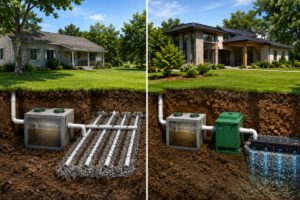
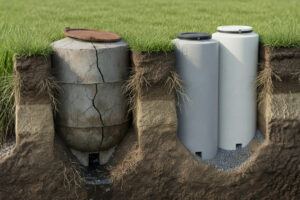
The conventional septic system is the foundation of residential wastewater management. It uses two parts, a septic tank and a drain field. It is all gravity and natural soil filtration-based. Wastewater flows into the tank, and solids settle out as sludge, while the clarified liquid percolates into the surrounding soil.
Why Conventional Systems Work, And When They Don’t
These systems are cost-effective, low-maintenance, and proven over decades. But they come with hard environmental requirements. If the soil is too dense (clay) or too porous (coarse sand), it will either clog or allow the untreated effluent to pass through too quickly, contaminating the groundwater in either case.
Types of septic systems for homes that fall under the conventional category:
- Gravity-fed systems
- Pressure distribution systems
- Chamber leach systems
What Are Advanced or Engineered Septic Systems?
Advanced systems are the answer when conventional systems are not an option, because of poor soil, small lot size, or high water tables. These are engineered solutions to treat the wastewater to a higher standard before it hits the ground.
Homeowners across Brighton, MI, Highlands, MI, and Milford, MI, increasingly encounter these requirements as lots get smaller and county regulations tighten.
Common advanced system types:
- Aerobic Treatment Units (ATUs)
- Mound systems
- Drip irrigation systems
- Recirculating sand filter systems
Think your property qualifies for a conventional system? Think again. Over 30% of Michigan properties assessed in high-density suburban areas require an advanced system, and most homeowners find out only after they’ve already broken ground.
How Conventional Septic Systems Work
The process is entirely passive. Wastewater flows from your home into the septic tank, where solids separate from liquids. The liquid effluent then flows to the drain field, where it seeps through layers of soil that naturally remove pathogens and nutrients. No power or mechanical parts. Just physics and biology doing their thing.
How Advanced Systems Work
Advanced systems add treatment stages between the tank and the dispersal field.
- Aerobic Treatment Unit vs. Conventional Septic
In an aerobic treatment unit vs. a conventional septic setup, the key difference is oxygen. ATUs aerate wastewater, where aerobic bacteria decompose organic matter far more aggressively than in conventional anaerobic systems. By the time it exits, the treated wastewater is a lot cleaner, which is important in environmentally sensitive areas.
- Mound Septic System vs. Traditional
A mound septic system vs. a traditional installation addresses one specific problem: inadequate soil depth. Rather than dispersing effluent into existing ground, a mound system creates an engineered sand bed above grade, so that proper filtration is still available even when the underlying natural soil cannot provide it. This is one of the most effective solutions for properties with shallow bedrock or seasonal saturation.
Pros and Cons: Conventional vs. Advanced
| Feature | Conventional System | Advanced System |
| Upfront Investment | Lower | Significantly higher |
| Maintenance Frequency | Every 3–5 years | Annual inspections required |
| Power Dependency | None | Often requires electricity |
| Soil Flexibility | Limited | Works in most conditions |
| Treatment Quality | Standard | Superior |
| Regulatory Complexity | Straightforward | More permits required |
Key Factors That Determine Which System You Need
Your property’s physical characteristics, not your preferences, determine which system is viable.
- Soil composition: Dense clay and extremely sandy soils both disqualify conventional drain fields.
- Lot size: The best septic system for small lots has to fit within tight setback requirements. Conventional drain fields demand space that many suburban lots simply don’t have.
- Water table depth: Any property requiring a septic system for high water table conditions needs a mound or advanced dispersal solution, not a standard gravity system.
- Proximity to water: Near lakes or wetlands? Your county health department will likely mandate advanced treatment.
Here’s a hard truth: installing the wrong septic system doesn’t just fail, it fails in a way that transfers liability directly to you. Environmental contamination traced to your system can result in fines, forced remediation, and even legal action from neighboring property owners.
Cost and Maintenance in 2026
We won’t list specific numbers here because the advanced septic system cost in 2026 varies widely depending on system type, soil conditions, local permit fees, and site access. Here’s what we’re going to tell you: the gap between conventional and advanced installation costs is real and significant, but so is the cost of installing the wrong system and replacing it within a decade.
Advanced systems also carry ongoing maintenance obligations. Many Michigan counties require annual service contracts for ATUs. Skipping these inspections doesn’t just void your warranty; it can violate your operating permit.
How to Choose the Right System for Your Property
Choosing the right septic system starts with professional site evaluation, not assumptions.
The Non-Negotiable First Step: A Perc Test
A percolation test tells you exactly how your soil absorbs water. This one result can take an entire class of systems off the table. No respectable contractor would recommend a system without one.
For New Construction
Septic installation options for new homes should be determined before site planning is finalized. Lot layout, building placement, and landscaping decisions all affect where and how a system can be installed. One of the most costly mistakes a homeowner can make is considering septic as an afterthought during new construction.
For Alternative Septic Systems for Difficult Soils
Properties with failed perc tests aren’t hopeless; they just require an engineered approach. Alternative septic systems for difficult soils like ATUs, drip systems, or mound configurations can work where conventional systems cannot, provided they’re properly designed and permitted.
When an Advanced System Is Worth Every Dollar
Advanced systems earn their cost when the alternative is a failed conventional system, a contaminated well, or a regulatory violation. Little choice is left to properties bordering protected waterways, in high-density suburban areas, or on small lots with restrictive setbacks.
The University of Minnesota Extension documented cases where homeowners who installed ATUs in environmentally sensitive areas avoided significant remediation costs compared to neighboring properties where undersized or poorly matched conventional systems had failed. The savings weren’t marginal; they were substantial.
The Bottom Line on Septic System Selection
There’s no universal answer to which system is right for your property, only the right answer for your specific soil, lot, and location. What’s installed two streets over may be completely unsuitable for your yard.
Watkins Septic & Drain has been navigating these decisions alongside Michigan homeowners since 1979. As a third-generation, family-operated business, our team serves Brighton, MI, Milford, MI, Highlands, MI, and communities across Livingston, Oakland, and Genesee Counties. We don’t recommend systems based on what’s easiest to install; we recommend what will actually work for your property, long-term.
If you’re weighing conventional vs. advanced septic systems, planning new construction, or dealing with a property that’s failed a perc test, don’t guess. The wrong decision made today becomes a very expensive problem within a few years.
Call Watkins Septic & Drain at 248-249-3574. Let’s assess your property, answer your questions honestly, and make sure your system is built to last.